Ipso Jure, or How the Peacock Got Its Tail
Our judicial system splits its own territory into matters of fact and matters of law. A matter of fact would be something like whether Person A killed Person B at Place X. A matter of law would be something like for how long we should put Person A in timeout because they killed Person B at Place X.
This distinction between fact and law hints at a certain instability: there is nothing solid at the core of our legal proceedings. No matter how knowledgeable lawyers and judges are, no matter how solemn their costumes and ceremonies and spells, no matter how many pillars we put in front of our courthouses, the whole affair boils down to some little human being, somewhere, looking at Person A and saying, “I don’t like his face. Fifty years!”
In lieu of any objective standard of justice we settle for the next best thing: consensus. Both matters of fact and of law hinge on agreement among people. Matters of fact are often left to jury members, who reach their verdicts by majority vote at the very least or by unanimous vote in criminal cases. Meanwhile, judges—the ones who have to resolve matters of law—feel they should go along with their peers’ precedents because of stare decisis, a doctrine urging consistency in judicial decisions over time.
While we’re dusting off Latinisms: the same distinction between fact and law gives us the phrases ipso facto (“by the fact itself”) and ipso jure (“by the operation of law”). Ipso facto actually removes the burden of consensus and rises into the realm of unassailable logic; it’s used to say that one thing is implied by another. A murderer, ipso facto, is a criminal. But ipso jure brings us back down to earth; it’s used for legal mechanisms, most of them convoluted, all of them rooted in popular human sensibilities. A murderer, ipso jure, forever loses the right to vote in Alabama.
The essential tension we see in the law—between what is true in some cosmic way and what is simply agreed upon—is present across domains. A lot of life, maybe most of it, maybe all, is not self-evident but must be determined ipso jure, in a manner of speaking. From the things we say, down to our very cells, the imprints of consensus are everywhere.
Blah Blah Blah
Besides law itself, linguistics offers maybe the best example of an ipso jure-type process. Like a legal code, a language is a practical resource, blooming or dying off or moving sideways based on how people use it. Many a young, wordy elitist (e.g., baby Jason) has a hard time dealing with this. They may bristle at the lack of boundaries, or at the idea that the same users who seem to care least about a language—the majority—are the ones who determine where it goes. They may become prescriptive grammarians. “Stop saying ‘is comprised of’!” they shout at people in Panda Express.
To these tortured souls the world gives its usual condolences: Cry more. Eventually, they tend to give up and become descriptive grammarians, more interested in what is happening with the language than in what should or should not happen.
And what is happening, always, is change, some of it logical but much of it violent or absurd. Consider for example the path of an everyday word like nice. It popped up in English in the 1300s, as a result of the Normans being boating enthusiasts and whacking-people-with-sticks enthusiasts several centuries earlier. In its earliest recorded use, it meant “foolish,” or “stupid,” aligning with the sense of its Latin root nescire: "not to know."
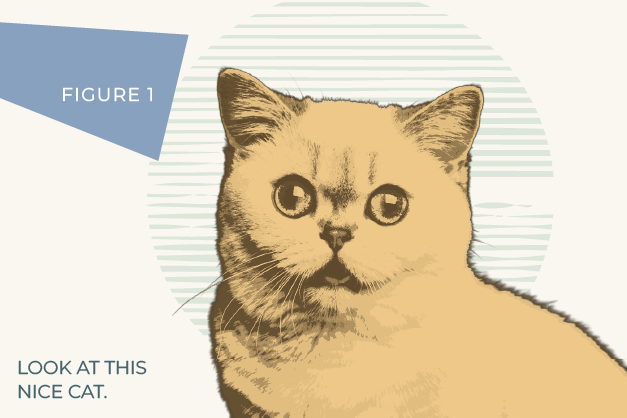
Around the 1500s, it took on the sense “picky” or “scrupulous about etiquette.” Then “refined” or “associated with polite society.” And now it’s a catch-all descriptor for the pleasant, agreeable, or admirable.
Through a series of popular shifts—each of which is easy enough to follow from the one before, but which together have bent the word 180 degrees—nice became something unimaginable to the people who gave it life. Is English better for it? Worse? Who knows! There’s no chance to talk about that, because linguistic upheaval continues to spread in a thousand directions at once, and the baby Jasons have more pressing tantrums to throw.
Another example, just for fun: Nimrod was a king in the Old Testament famous for his skill in hunting. In the 1500s nimrod briefly became equivalent to tyrant, but in the 1600s it branched off as a generic title for a hunter. Would this begin a prestigious new era for the word? Would outdoorsy English-speakers everywhere beam with pride to see themselves described as nimrods? No, they would not. The problem was that, to anyone with ears, nimrod is really, really funny-sounding, and ironic instances of the word began to out-compete sincere ones, fed by an abundance of stories where somebody fell in a pond or shot their friend in the butt with an arrow or whatever.
In American English around the 1970s, the insult to King Nimrod’s legacy reached its zenith, as the original meanings of the word faded altogether except in outdoor literature, and it became a term for any hapless dumbass whether a hunter or not.
Ipso jure strikes again!
Forced Looksmaxxing
“Survival of the fittest”—a phrase apparently invented by someone named Herbert Spencer in 1864 and adopted by Darwin later—is the most famous way to sum up natural selection. “Survival of the good enough” might be more precise, however. It’s appealing to think of natural selection as an agent guiding forms of life toward perfection, but it’s mostly just another name for blind probability, and it does a lot more culling of ruinous genetic combinations than promoting of improvements.
If an organism is fit enough to reproduce under the current conditions of the world, it continues, no matter how brief, clumsy, inefficient, or miserable its life. The evidence for this claim: sloths. There are still sloths around. No doubt they’re well-adapted to their environment, but still. Don’t try to tell me they want to be sloths.
What’s more, fitness in the evolutionary sense is heavily weighted toward the first part of life, so that many traits persist which are helpful at first but harmful later. Suppose there was a certain genetic combination that led to immense reproductive success early on and then made an organism’s head explode well before it reached the limit of its species’ lifespan. Would that trait be selected for or against? Probably, we would expect it to flourish, assuming a sufficient number of the trait-bearing offspring were able to survive and reproduce in turn without much parenting.
Into this already strange and complex engine, a wrench is thrown ipso jure: sexual selection. As an undercurrent within natural selection, sexual selection adds to the silent, abstract judgment of the environment upon its inhabitants with the judgment of the inhabitants upon themselves.
The classic case in point here is the peacock. Female peafowl (AKA peahens) love a big, colorful tail. Maybe it signals good health. Maybe it signals effort. Maybe it reminds them of blueberries, which they also love (I’m guessing). We cannot be sure. In any case, each spring, they choose as a mate the peacock with the most extravagant tail they can find. This introduces positive selection pressure in the male population: bigger tail trait→more reproductive success→more baby peacocks carrying the trait for big tails.
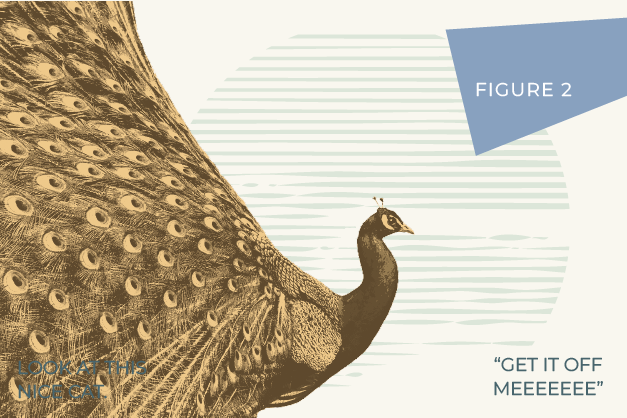
As a result of this pressure, the average splendor of the males’ tails increases generation by generation, but the peahens’ preference is always for the most splendid of all, creating a runaway feedback loop. That has continued to the point that the male’s tail is an obvious crisis for his health and happiness. It diverts calories away from everything else, like his brain, which, let’s be honest, was not going to win him any Rhodes Scholarships to begin with. It’s bright and attractive to predators. It’s so heavy that he can barely fly away from all the predators it attracts (while the females zoom off without a care in the world). Stare into a male peafowl’s eyes, and you will see true pain (Figure 2).
Despite these drawbacks, the feedback loop is likely to continue, until the tails cross a size threshold where they finally become so cumbersome that they keep affected peacocks from reproducing much (because they kill the peacocks first).
Other examples:
Elk antlers, last seen getting snagged on every tree in the forest as their owner tries to escape something scary
The huge bodies of male elephant seals, which require ∼200 pounds of food per day and render them six times more likely than females to die from predation during foraging trips or from starvation
The intricate calls of male túngara frogs, which attract mates but also sound like this to the bats that eat the frogs: “HEY I’M OVER HERE AND I’M VERY JUICY AND FULL OF VITAMINS”
Sexual selection shares a property with the forces driving change in language and law: they all use consensus for fuel, and they cannot use ideals. It would be ideal if traits were selected for only when they made the organism more likely to survive and to reproduce and to enjoy a high quality of life. It would be ideal if the evolution of a language were part of some careful design, making it logically consistent, easy to learn, and intelligible over centuries. It would be ideal if our legal decisions had some higher source of authority than our fee fees and tradition (which, really, is just the fee fees of the past).
But this is not so. Instead we have ipso jure, revealing solutions acceptable to most parties most of the time, or at least preferable to the alternatives, across a wild, imperfect landscape.
So much of our experience is up to us to decide, piece by piece, generation after generation.
Is that bad? Is that OK?
Maybe we should vote on it.